
Audit Overview
Your store's untapped revenue potential — and how to unlock it
Why We Created This Audit
We analyzed petites-pommes.com the same way we've audited 350+ e-commerce stores — looking for the specific gaps between your current experience and what top-performing Fashion stores deliver. Every finding in this report is a revenue opportunity backed by industry data and competitive benchmarks.
What We Analyzed
- UX & Conversion Design9 findings
- Technology & App StackPlatform + 5 apps
- Industry BenchmarksFashion
Pages Analyzed
- Homepage1 findings
- Collection Pages3 findings
- Product Pages (PDP)2 findings
- Cart & Checkout2 findings
 This audit was prepared by Growisto — a CRO-led Website development team behind 167% conversion growth for Atomberg, 46% CR lift for TyresNmore, and 350+ e-commerce projects.
UX & Conversion Findings
Page-by-page analysis with visual comparisons against top Fashion stores
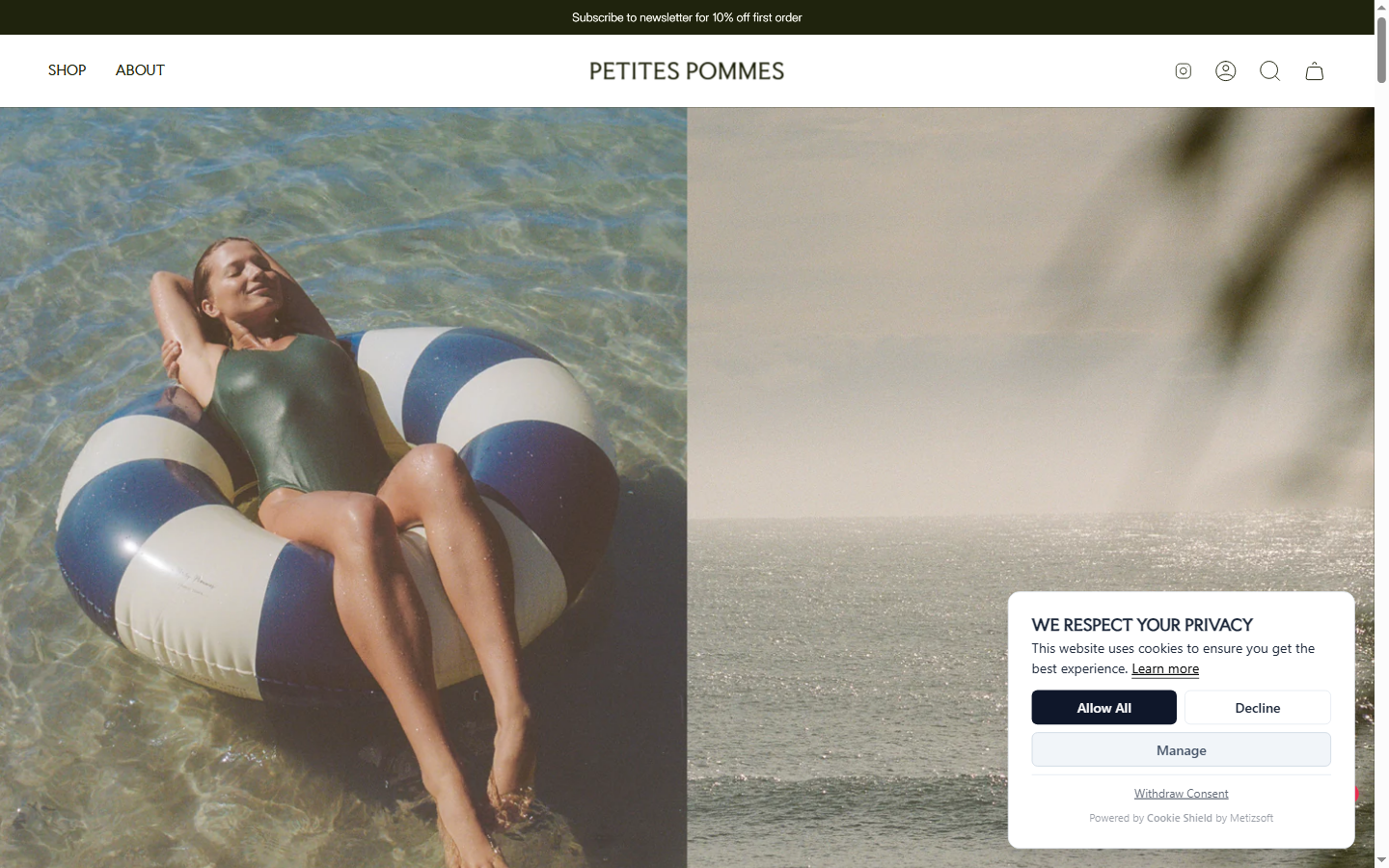
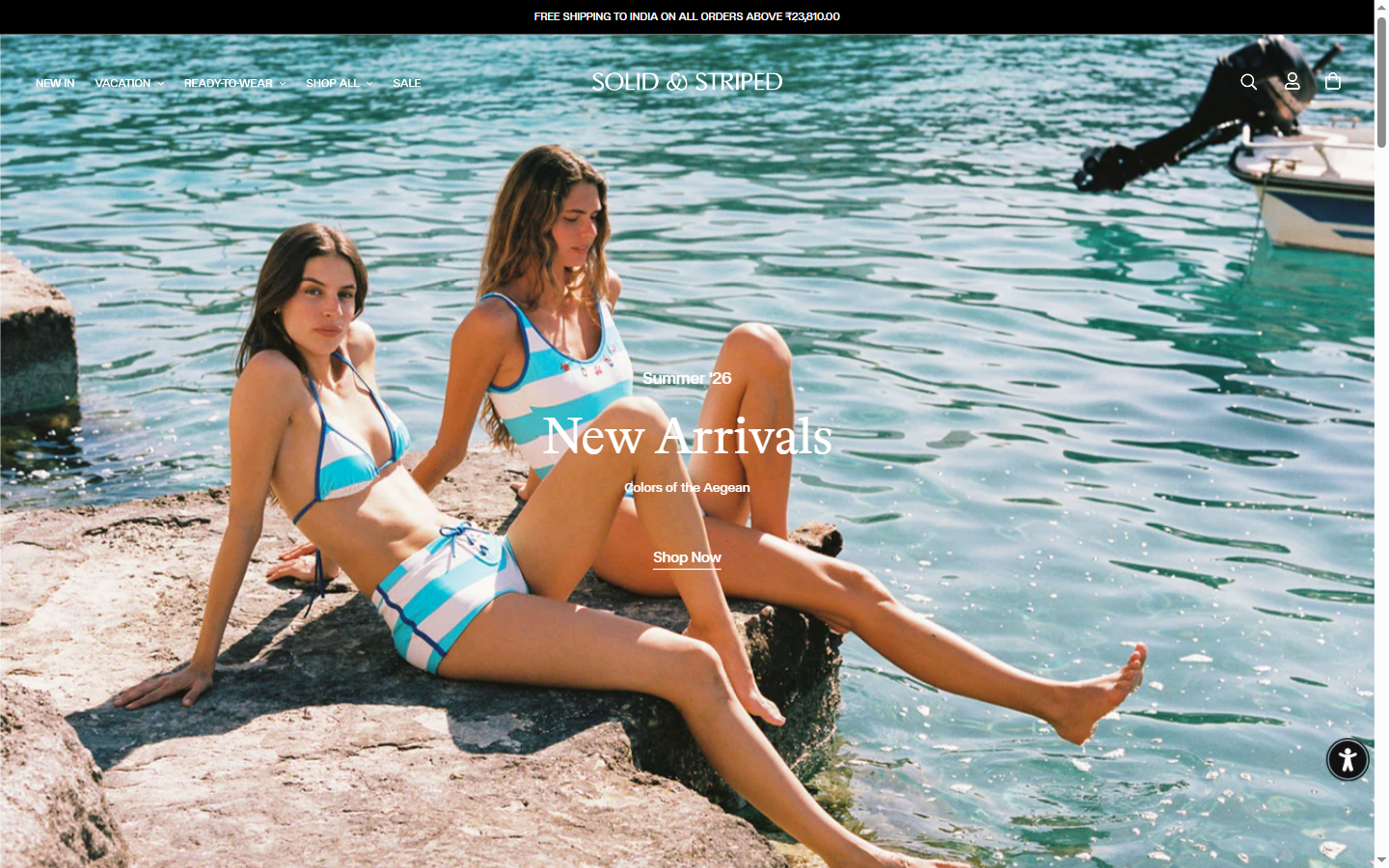
- Petites Pommes' homepage prominently features a hero banner, product category navigation, and an 'As Featured In' press strip (Vogue, Marie Claire, Elle Décor, Financial Times) — but has no visible customer testimonials, review excerpts, star rating aggregate, or user-generated content section. A new visitor from paid or organic traffic has no peer evidence that the products perform as beautifully in real life as the lifestyle photography suggests.
- 7 of 10 fashion benchmark stores display reviews or testimonials on the homepage. Solid & Striped features a curated customer photo section alongside written testimonials — pairing visual UGC with text quotes. Hunza G displays star rating aggregates prominently in the header area, creating persistent social proof throughout the session.
- Petites Pommes does have static 5-star testimonials on individual PDPs — indicating that real customer feedback exists. The gap is in surfacing the strongest quotes on the homepage where new visitors form their first impression. A €150+ free shipping threshold signals a premium price point; the higher the price, the more important social proof becomes for converting first-time visitors who arrive with no prior brand familiarity.
- The brand's media coverage (Vogue, Financial Times) builds aspirational positioning but does not address the purchase-stage question: 'Will this float/swimsuit actually look as good when it arrives?' Customer testimonials that reference the quality of materials, the accuracy of the photography, and the unboxing experience close this gap in a way that press logos cannot.
- Add a 3–4 review carousel section to the homepage featuring testimonials that reference product quality, colour accuracy, and delivery experience — the three primary questions a first-time visitor has. Pull the best quotes from the existing PDP testimonials as a starting point.
- Include a star aggregate badge ('★ 4.9 from 2,400+ reviews') near the hero section or site header — this acts as persistent social proof across the entire session and immediately signals that Petites Pommes has a large base of satisfied customers.
- For mobile specifically, a sticky header strip showing '★ 4.9 / 2,400+ verified reviews | Free EU Shipping €150+' provides an immediate trust layer for visitors who may bounce before scrolling to a mid-page reviews section.
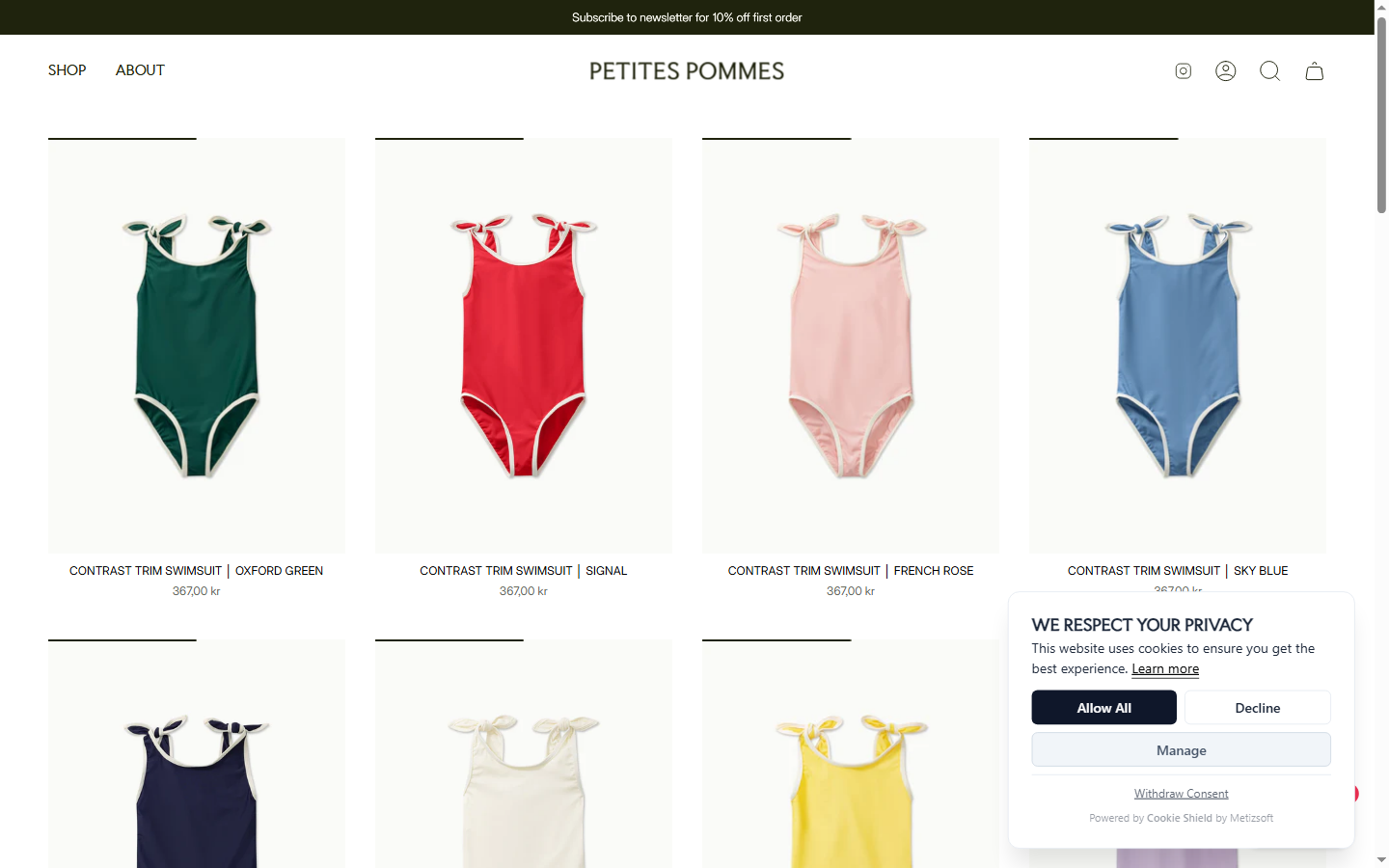
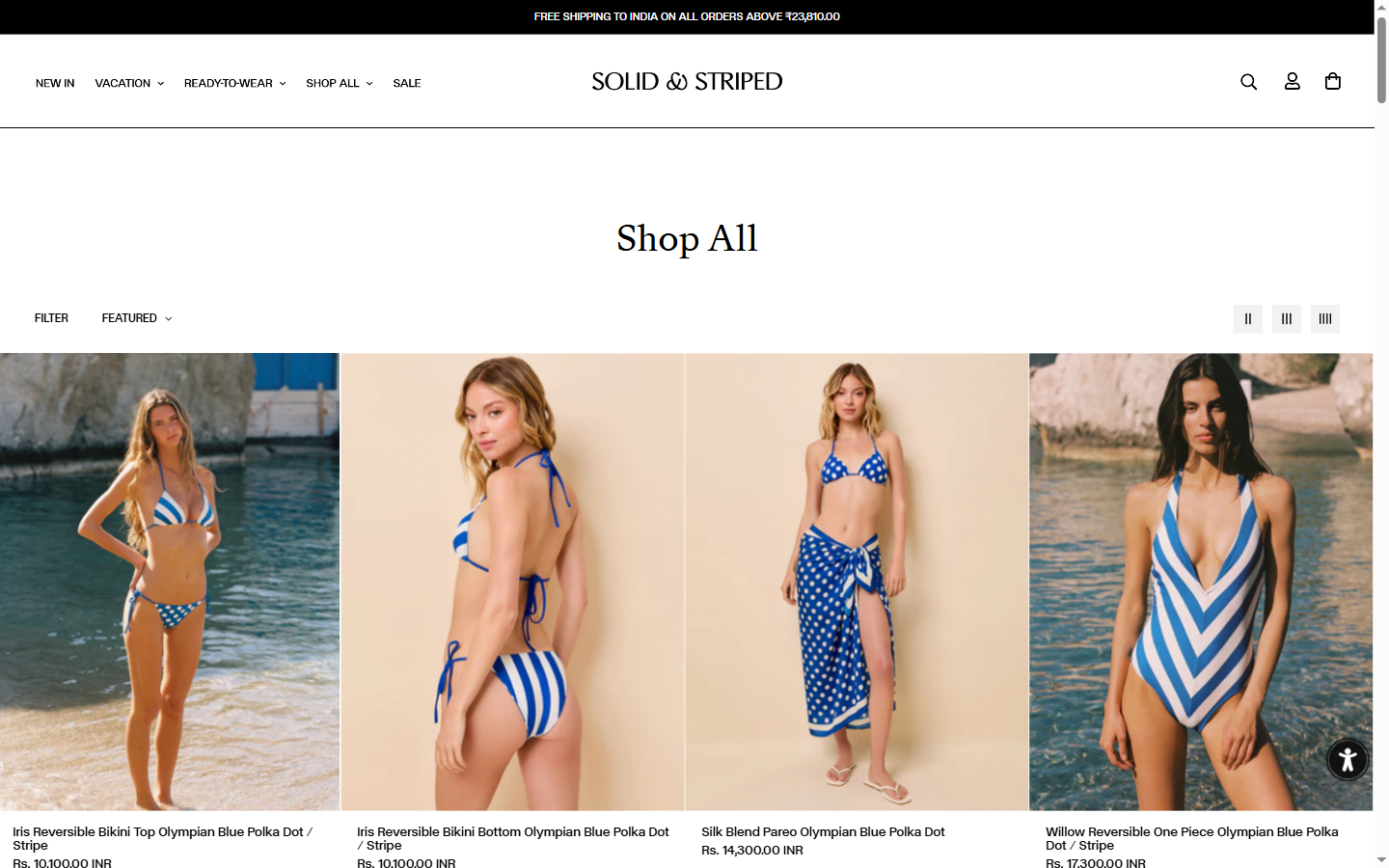
- Petites Pommes' collection cards display product images, names, and prices — but no star rating or review count. A shopper browsing the Swimwear or Classic Floats collection has no social proof cue at the browse stage to distinguish which products have the strongest quality track record or widest customer approval.
- 8 of 10 fashion benchmark stores display star ratings on collection cards. This is particularly important for Petites Pommes because the catalog spans multiple product categories (floats, swimwear, goggles, towels, bags, sandals, suncare) with varying price points and quality levels — a new visitor browsing across categories relies on review signals to guide which specific products are most trusted.
- The absence is especially damaging for high-consideration items like swimsuits (367 kr) and snorkel sets (598 kr). A shopper choosing between multiple swimwear colour variants at the same price point has no data-driven signal to guide selection — review count and rating is the most reliable proxy for quality confidence at the collection page level.
- Petites Pommes has static 5-star testimonials on individual PDPs, confirming that review content exists on the site. The gap is surfacing review data at the collection card level where it drives browse-to-click decisions — the majority of session abandonment in e-commerce occurs at the collection browse stage, not on the PDP.
- Activate review app collection card rating widgets — most Shopify review apps (Judge.me, Okendo, Yotpo) include a collection card snippet that adds star rating and review count below the product name with a single settings toggle. This typically requires no theme code changes.
- For new products with fewer than 10 reviews, display a 'New' badge instead of stars — this avoids showing a statistically insignificant rating and keeps the browse stage honest. Once products cross the 10-review threshold, switch to the aggregate score.
- Pair the star rating with review count as a number ('★ 4.9 · 312 reviews') rather than just stars — the count acts as a social proof multiplier. A 4.9★ from 312 reviews is substantially more persuasive than 4.9★ alone, particularly for a first-time visitor comparing two similar float colours.
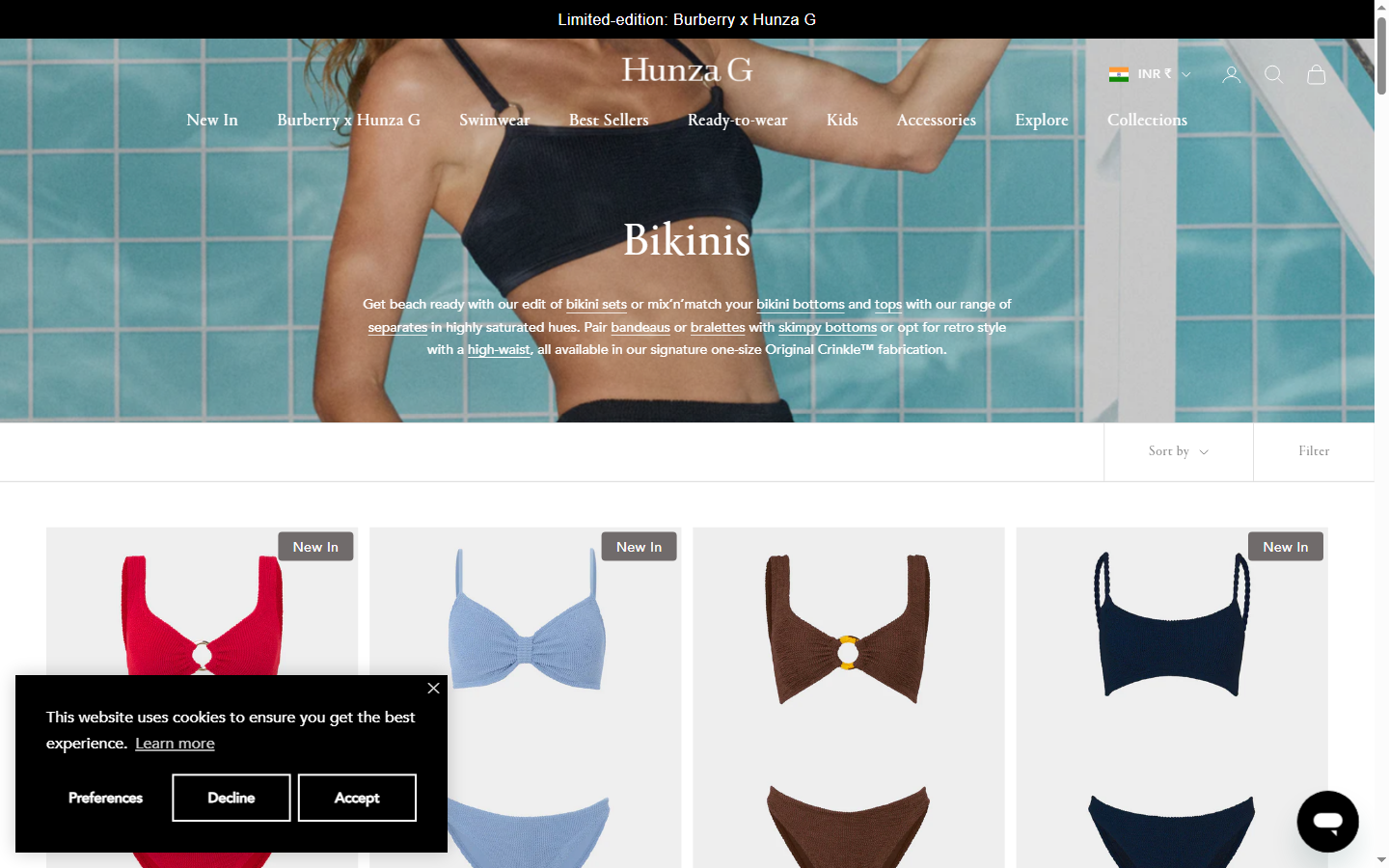
- Petites Pommes' collection pages show no filter sidebar, filter dropdown, or sort-by control. The only colour navigation available is a 'Shop by Colour' link in the main navigation — but within individual category collections (e.g. Swimwear, Classic Floats), there is no way to narrow products by colour, price range, or subcategory.
- 9 of 10 fashion benchmark stores offer filter and sort options on collection pages. Hunza G provides filter by colour, size, and product type on its collection pages. Vilebrequin offers filter by colour, print, and price. The ability to filter by colour is particularly important for Petites Pommes, whose brand identity is strongly colour-driven and whose products are predominantly available in multiple colourway variants.
- Petites Pommes' catalog is organised across at least 12 categories (Classic Floats, Swimwear, Goggles, Towels, Accessories, Bags, Sandals, Kids Pools, Pool Play, Armbands, Suncare, and new seasonal products). As the catalog grows, the absence of filtering becomes progressively more damaging — shoppers who arrive knowing they want 'Oxford Green' products or products under €50 have no efficient path to discover them.
- The Swimwear collection includes separate cards for each colour variant of the same product (e.g. the same swimsuit in Oxford Green, Tangerine, Denim, French Rose, Sky Blue). Without colour filtering, the collection page is effectively a flat list of colour cards — a high-cognitive-load experience for shoppers trying to assess the range.
- Install Shopify's free Search & Discovery app, which adds filter and sort functionality to collection pages with no custom development required. Enable filters for: Colour (high priority given brand identity), Price Range, Product Category, and New Arrivals. Sort options: Bestsellers, Price Low–High, Newest.
- For the Swimwear collection specifically, implement a 'Shop by Silhouette' filter (One-Piece, Bikini, Swim Shorts, Sun Shirt) to help shoppers narrow to their preferred style before seeing colour variants — this reduces the perceived catalog size from ~30+ cards to a manageable 8–10 per silhouette.
- Add a persistent filter pill bar above the product grid on mobile — showing active filters as dismissible chips ('Colour: Oxford Green ×'). This mirrors the approach used by Vilebrequin and is the standard mobile filter UX for premium fashion D2C brands.
- Petites Pommes' collection cards have no heart icon, bookmark, or save-for-later button. A shopper comparing pool floats across colour variants or building a summer kit (float + swimwear + towel + bag) across multiple sessions has no way to save products without relying on browser history or screenshots.
- 7 of 10 fashion benchmark stores have wishlist functionality. Hunza G shows a heart/save icon on product cards and tracks wishlist items in the navigation header. For a premium, aspirational brand like Petites Pommes, wishlists serve a dual purpose: they enable the multi-session consideration purchase (common for €100–600 kr premium items) and provide the brand with intent signals for retargeting and personalised email flows.
- Petites Pommes' seasonal product drops — new colourways added each season — make wishlist particularly valuable. A shopper who saves products from the current season's catalog during browsing, but doesn't purchase immediately, represents a high-intent lead who can be re-engaged with 'Still in your wishlist' email nudges or notifications when new colours arrive in a saved style.
- The brand's premium positioning (featured in Vogue, Elle Décor) and lifestyle photography suggest a shopper who browses aspirationally and may take multiple sessions to decide. Without a wishlist, this consideration window is entirely invisible to Petites Pommes — no retargeting signal, no email flow, no second-chance to convert.
- Add a heart/save icon as an overlay on every collection card (top-right corner) and on every PDP beside the Add-to-Cart button. For guest shoppers, save to local storage; prompt account creation to persist across devices.
- Surface wishlist count in the navigation header ('♡ 3') — this creates a persistent return-visit incentive and reminds shoppers across every page of the session that they have unfinished browsing to complete.
- Connect wishlist to email flows: send a 'Your saved items are still here' email 24–48 hours after a visitor saves products without purchasing. For new colourway launches, send a 'New colours added to a style you saved' notification — this turns the seasonal drop model into a direct re-engagement mechanism for the warmest segment of the audience.
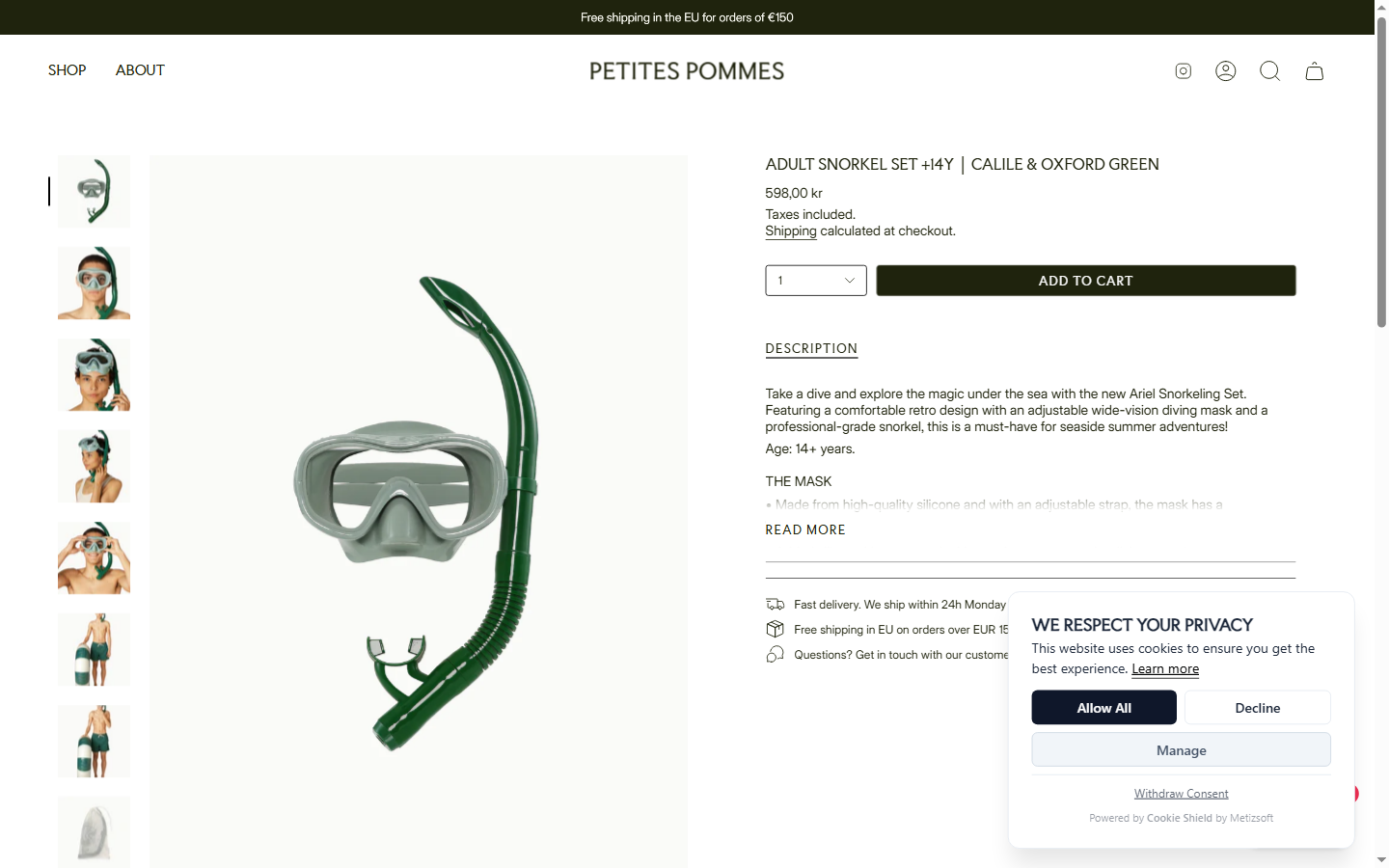
- Petites Pommes PDPs display 4 static 5-star testimonials (hardcoded text, no review counts, no verified purchase badges, no star aggregate in the page title or header). On the Adult Snorkel Set PDP (598 kr), testimonials include quotes like 'Incredibly chic with lovely wrapping' and 'Speedy delivery and your customer service is outstanding' — positive, but not product-specific quality signals that a first-time shopper needs to make a purchase decision.
- 10 of 10 fashion benchmark stores display a full verified review section on PDPs. This is the single highest-adoption standard pattern in the entire fashion category. Hunza G shows a review section with star aggregate, review count, verified purchase badges, and customer-submitted photos. Solid & Striped displays detailed review content with star breakdown charts. Both use the review section as a primary conversion tool — not just a trust decoration.
- The current testimonials have critical credibility gaps: all 4 are 5-star (no distribution showing genuine variance), there is no review count (new visitors cannot tell if there are 4 reviews or 4,000), and there are no verified purchase indicators. Studies consistently show that shoppers trust review systems with some negative ratings more than systems showing only perfect 5-star scores — the current implementation appears curated rather than authentic.
- Petites Pommes' product catalog spans 12 categories with very different product types (pool floats, swimwear, suncare, kids armbands). A shopper evaluating a €150 pool float needs different reassurance than one buying a €20 suncare product — a review app enables product-specific Q&A, photo reviews showing floats in actual pools, and size/fit notes for swimwear. Static sitewide testimonials cannot serve this role.
- Install a Shopify review app — Judge.me (free tier available), Okendo, or Yotpo — and migrate the existing testimonials into the review system. Enable: verified purchase badges, photo review uploads, star aggregate display above the fold on every PDP, and a 'Most Helpful' sort order to surface quality signals first.
- Send a post-purchase review request email at 14–21 days (after delivery to EU destinations) with a product-specific prompt: 'How did your Oxford Green Float perform in the pool this summer?' Photo-incentivised requests ('Submit a pool photo to earn 10% off your next order') drive higher photo review submission rates — particularly valuable for a lifestyle brand where real-life imagery is the primary trust lever.
- For the swimwear category specifically, add optional sub-ratings: 'True to Size', 'Material Quality', and 'Colour Accuracy' — these map directly to the top objections for swimwear online purchases and allow future shoppers to find the specific information that converts their hesitation.
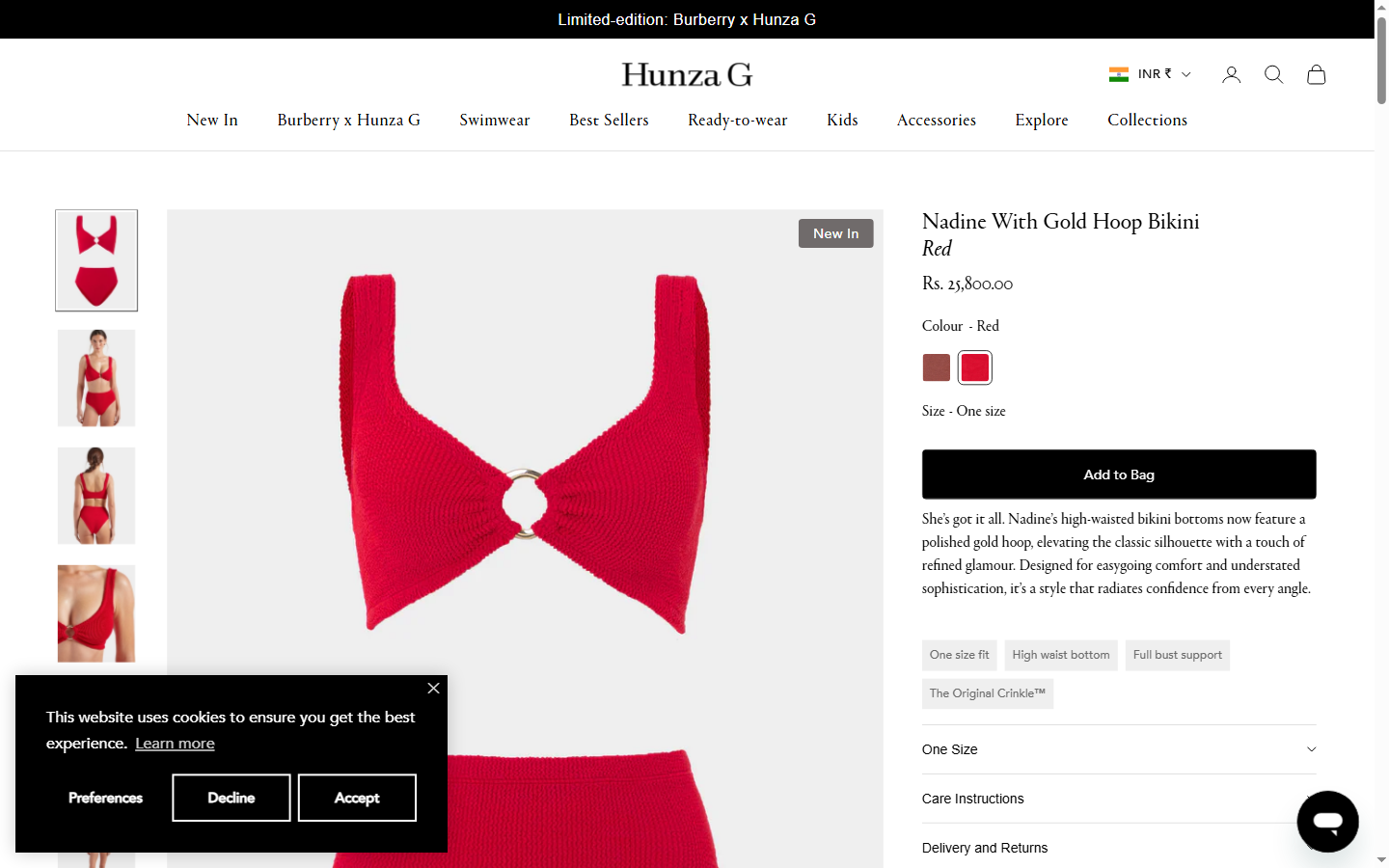
- Petites Pommes PDPs display price, variant selector, and the Add-to-Cart button — but no BNPL or pay-later messaging. For a swimsuit at 367 kr (~€49) or a snorkel set at 598 kr (~€80), Klarna messaging removes the single largest checkout objection for European shoppers evaluating whether to buy now vs. wait.
- 9 of 10 EU/Global fashion benchmark stores display Klarna (or Afterpay/Clearpay) messaging on the PDP directly below the price. Hunza G — a UK-based premium brand in the same swimwear category — displays Klarna pay-in-3 messaging on all PDPs. Vilebrequin (French luxury swimwear) similarly surfaces pay-later options on product pages for the EU market.
- Klarna's market penetration in Scandinavia (Sweden, Denmark, Norway) is among the highest globally — Klarna was founded in Sweden and has dominant market share in the DACH and Nordic regions. A Copenhagen-based brand without Klarna on PDPs is missing the primary pay-later tool for its home market audience. For repeat-purchase scenarios (new season, new colourway) the BNPL option also increases AOV by reducing the psychological barrier to higher-value basket builds.
- Petites Pommes' multi-currency checkout (25+ countries) suggests a deliberate effort to serve international markets — yet BNPL options vary by market. Klarna operates in 45+ countries and can handle EU, UK, US, and APAC payment flows through a single integration, making it the right BNPL choice for a brand with Petites Pommes' geographic footprint.
- Integrate Klarna via the official Shopify Klarna Payments app (free, 15-minute install) and display 'or 3 interest-free instalments with Klarna' below the product price on every PDP, dynamically calculated per product price. Klarna provides a fully localised widget that displays the correct pay-later option for the shopper's country.
- For cart-level reinforcement, add a Klarna banner above the checkout button: 'Pay in 3 interest-free instalments — no sign-up required.' This ensures BNPL visibility at the highest-checkout-intent moment and reduces cart abandonment for shoppers hesitating on a 500–1000 kr combined order.
- Consider displaying a Klarna badge in the site announcement bar alongside the free shipping message: 'FREE EU SHIPPING ON €150+ · PAY IN 3 WITH KLARNA'. This ensures pay-later visibility across every page of the site, not only on PDPs where the shopper has already committed to viewing a specific product.
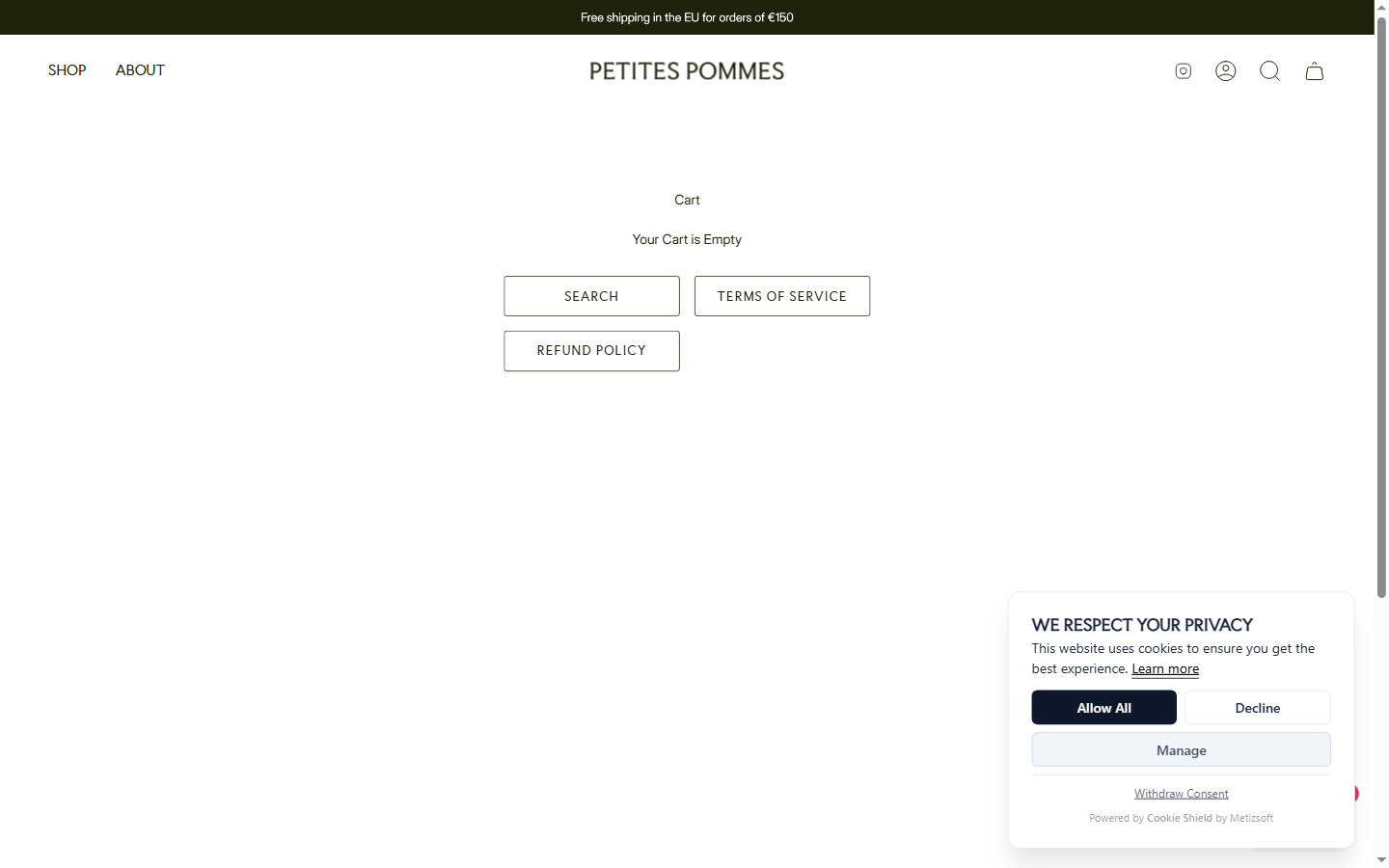
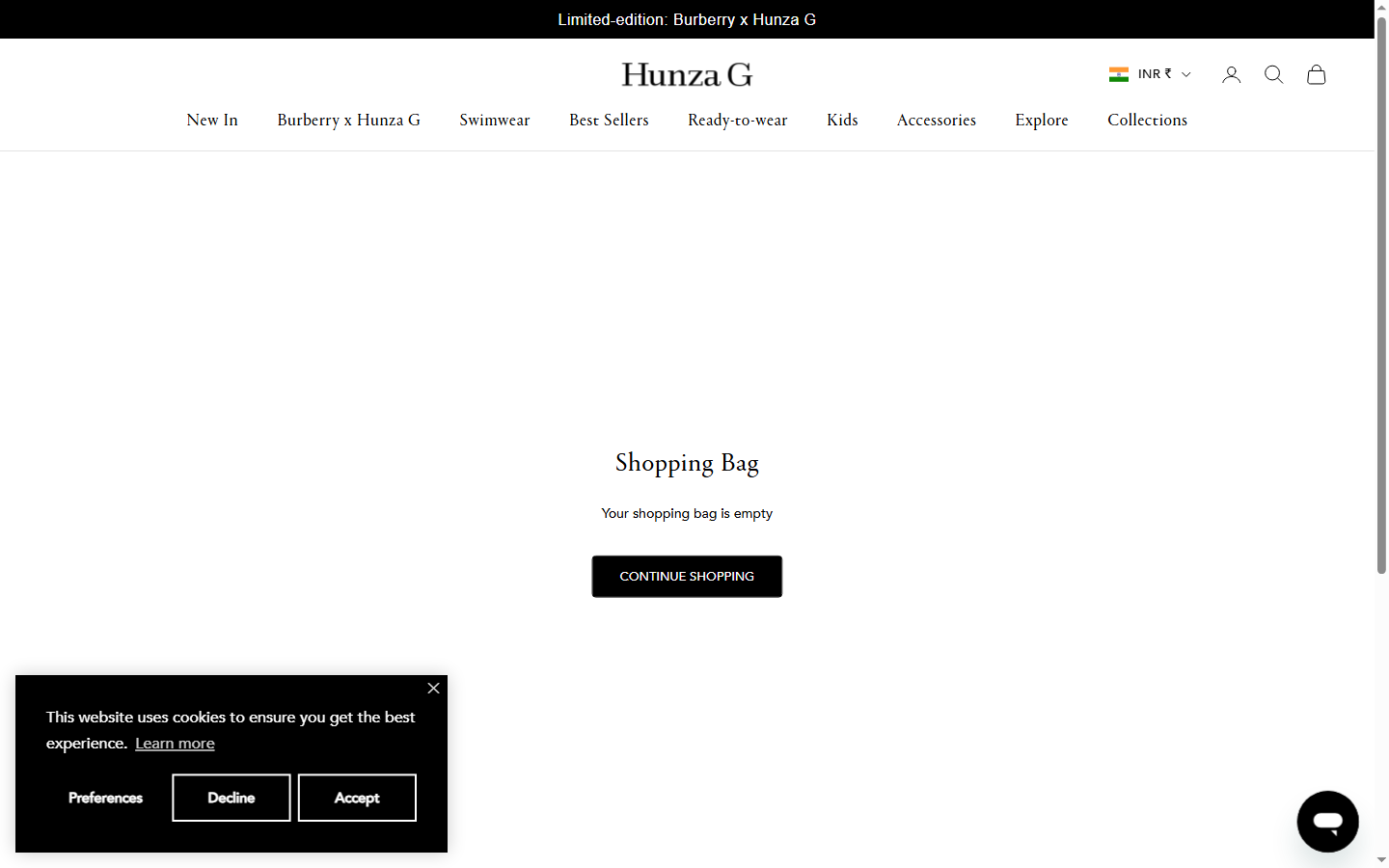
- Petites Pommes' cart page shows the €150 free shipping threshold only in the site announcement bar at the top of every page — but the cart itself has no dynamic progress bar or inline messaging showing how much more a shopper needs to add to unlock free shipping. A shopper with €95 in their cart has no visual prompt showing 'Add €55 more to get free EU shipping'.
- 8 of 10 fashion benchmark stores display a cart progress bar or inline threshold messaging. Hunza G shows 'You're £X away from free shipping' with dynamic messaging that updates as cart items change. Vilebrequin surfaces the free shipping threshold as a prominent cart page call-out. Both implementations drive measurable AOV lift by making the incentive actionable at the moment of highest purchase intent.
- The free shipping threshold is one of the most effective AOV levers in e-commerce — industry data shows 73% of shoppers say free shipping is the #1 reason they would add more items to their cart. At Petites Pommes' price points (367–598 kr per item), a cart with one swimsuit (367 kr / ~€49) needs only one more product to unlock free shipping — surfacing this gap in the cart converts the 'I'll come back later' decision into an immediate cross-sell opportunity.
- Petites Pommes' cart currently shows a 'Pair with' section (likely cross-sell products when items are in cart) — a strong signal that the site already attempts cart upsell. A progress bar above this section would provide the motivating context ('Add 1 more item to unlock free shipping') that makes the cross-sell recommendation feel purposeful rather than incidental.
- Implement a dynamic free shipping progress bar at the top of the cart page showing: 'You're €X away from free EU shipping on this order' with a visual fill bar. When the €150 threshold is crossed, replace with a success state: '✓ You've unlocked free EU shipping!' in brand colours.
- Below the progress bar, show 3–4 'Add to unlock' product recommendations priced at €10–40 — Petites Pommes' accessories, suncare, and armbands price range. These push the cart over the threshold while introducing the broader catalog to shoppers who may not have browsed beyond their initial category.
- Consider also surfacing a '+ Add matching towel' or '+ Add float' cross-sell prompt specifically when a swimwear item is in the cart — a coordinated set recommendation that is on-brand for Petites Pommes' 'coordinated looks for kids and adults' positioning and drives higher AOV through lifestyle bundling.
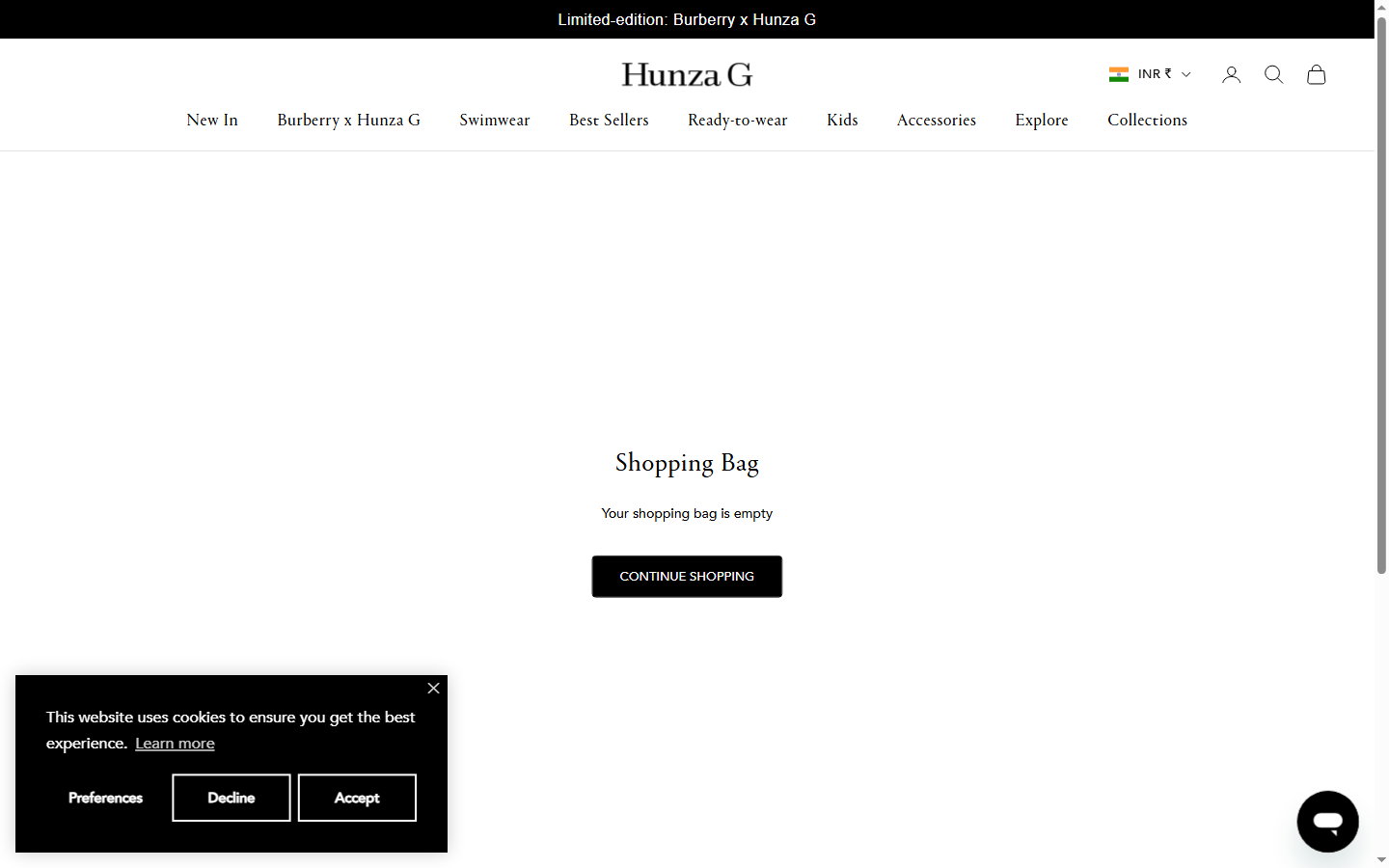
- Petites Pommes' cart page does not display a discount code or promo code input field. A shopper who received the 10% first-order discount from the homepage email popup — Petites Pommes' primary list-building incentive — has no way to apply their discount until they reach the Shopify checkout step. This creates a friction point that is particularly damaging when the shopper is unsure if the code is valid or whether it applies to their specific cart.
- 9 of 10 fashion benchmark stores include a discount code field on the cart page. Hunza G and Vilebrequin both display a collapsed 'Enter promo code' field in the cart. Shoppers who have a code expect to apply it in the cart — if they don't see the field, they may assume the code won't work and abandon rather than proceeding to an uncertain checkout experience.
- This gap has a direct impact on Petites Pommes' email programme ROI. The entire homepage email popup is built around the '10% off your first order' incentive — the primary conversion mechanism for the welcome series. When the recipient arrives from a welcome email, adds items to cart, and cannot find where to apply their code in the cart, a meaningful fraction of this warm, high-intent segment abandons. The cart page is where the email programme's conversion happens.
- The risk is asymmetric: showing a discount code field costs nothing when no code is being applied, but hiding it creates confusion and abandonment for shoppers who have one. Given that Petites Pommes actively captures emails with a promo code incentive, a significant and measurable share of cart visits will arrive with a code in hand.
- Add a collapsed 'Have a promo code? Click to enter' accordion field on the cart page, displayed above the cart total. The collapsed default prevents suggesting to shoppers without codes that they are missing a deal — while ensuring it is immediately visible and accessible to those who have one.
- For the welcome email flow specifically, include the discount code prominently in the cart reminder CTA — 'Use code WELCOME10 at checkout' — so recipients who receive the cart abandonment email arrive knowing exactly where to apply their code. Pair this with the cart page discount field for a seamless experience.
- Ensure the discount code field is persistent: if a shopper adds a code, browses more products, and returns to the cart, the code should still be applied. A disappearing code on cart navigation is a common source of customer service complaints and represents a conversion failure for the brand's primary lead nurture sequence.
Performance & Technology
Core Web Vitals, page-speed signals, and the technology stack powering Petites Pommes
Core Web Vitals
Technology Stack
Performance & Technology Assessment
Mobile performance is needs work (61/100); desktop is needs work (64/100) on Shopify. Page-speed and Core Web Vitals are increasingly load-bearing for SEO and conversion in this category — addressing the weakest vital first is the single highest-leverage technical improvement available.
Confidential — Prepared for Petites Pommes by Growisto | June 2026
App Ecosystem
What's installed vs what's missing from best-in-class Fashion stores
Present (5)
Missing (6)
App Stack Assessment
Petites Pommes' app stack has a clean foundation — active email capture with a first-order discount, multi-currency checkout, and form spam protection are all genuine assets for a Copenhagen-based brand serving 25+ countries. The critical gap is in the conversion trust layer: the static testimonial display on PDPs is not a substitute for a full review app (no star aggregates, no review counts on collection cards, no verified badges, no shopper-added reviews), BNPL/Klarna is absent despite being the standard for EU premium fashion, and the cart has no progress bar to surface the €150 free shipping threshold. These three gaps represent the highest-concentration conversion opportunity in the audit. All three are available as Shopify apps with straightforward installs: Judge.me or Okendo for reviews (2–4 hours), Klarna Shopify widget (15–30 minutes), and a cart app like CartHook or Shopify's native threshold messaging (1–2 hours). Closing these three gaps alone has the potential to meaningfully lift overall site CVR and AOV.
Confidential — Prepared for Petites Pommes by Growisto | June 2026